
There are two main types of electronic locking devices:
“Fail Secure” and “Fail Safe”.
A “Fail Secure” electronic lock remains locked when power is lost thereby providing continued security of cargo.
“Fail Safe” electronic locks unlock when electricity is removed thus providing more safety to personnel in the event of an emergency.
Fail Safe Electromagnetic Locks
Electromagnetic locks are only available as “Fail Safe” locks. That means magnetic locks do not work when there is no power.
Electromagnetic locks mount on the door frame and the door itself. The electromagnetic lock remains locked until there is no power to the magnet.
For safety reasons, some electromagnetic locks have a release button near the door. Other electromagnetic locks have an access button that can cut the power to the lock. Some countries require a second release mechanism in case of fire. This can be accomplished by use of motion sensors, crash bars, an internal switch to unlock the door, among others.
Advantages of Electromagnetic Locks
Magnetic locks can be turned on or off remotely by disrupting the power to the lock.
Magnetic locks are easier to install than other locks since there are no moving parts.
Magnetic locks unlock immediately when the power is cut, allowing immediate access.
Magnetic locks are stronger against physical attacks on the electromagnetic locking device.
Disadvantages of Electromagnetic Locks
Magnetic locks must have constant power to be secured.
Magnetic locks automatically open disabling security with power loss.
Magnetic locks are more expensive than mechanical locks.
Magnetic locks may require additional hardware for safe operation.
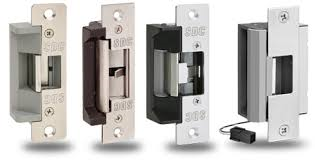
Fail Secure Locks
The picture on the left shows four different Fail Secure locking devices for doors.
Fail Secure locks are designed to protect property because the locks remain closed if the power is off. Fail Secure locks use technology known as electric latch retraction (EL). EL locks need power to retract the latch and unlock the door. The latch stays in a retracted position as long as power is applied. As soon as the power is off, the latch projects out again locking the door.
Is this important?
Ask the logistic service providers at the Rome airport who did not have power to their buildings for over 48 hours after the airport was hit by lightning. The alternative for some companies was to have a physical guard at all entrances with electromagnetic door locks.